Not so long ago I had time to kill – 30 minutes – while I waited to meet my son who was swimming at our local leisure centre. Here in Cleethorpes, on the Lincolnshire coast at the mouth of the Humber estuary, the centre is situated at the southern end of the promenade; behind it, the start of the dunes and salt marshes that stretch for miles down the coast.
Having my camera with me I thought I might like to make a few photographs to pass the (short) time I had and I chose to wander an area between embankment and dunes which was filled with a variety of grasses and other coastal plants.
Dropping down into that place was like entering another world: a strong wind was blowing and the dominant sound was the rustle of grasses as they swayed this way and that. My attention was drawn to the dance, to the accompanying music. I made some attempt to capture that motion, that sense of rhythm and mostly failed, as in the photograph above. Walking on, my thoughts turned to the notion of sea nymphs and I wondered if there was a goddess of the salt marsh. And this the mouth of the Humber estuary. Hardly the place of exotic myth and, though it had its own particular beauty, the only sirens likely to be heard were those of fog-bound ships. I made too many photographs during my short time in that place: photography offers a great intimacy between photographer and subject – whatever the genre – and I was pleased to have a result. Just one frame that went some way to expressing how I felt, listening and watching and all that jazz. Here it is:
I recently revisited that place and discovered that all the grasses had been cut down. They will be back next year. And there is a goddess of the salt marsh (I googled it): she is one of the Nereids of Greek mythology and her name is Lymnoria.
‘If you want to lift yourself up, lift up someone else’
Booker T Washington (1865-1915)
A friend got in touch recently. A tour manager and sound engineer, he wondered if I would be interested in spending a few days documenting the setting up of a stage show with the crew of a well known rock band. The band were due to tour the USA (as I write, they are in Detroit), it would be their fiftieth anniversary (deferred by a year due to the restrictions of the Covid pandemic) and it would be special. Aside from a few shots I would be left to my own devices. I would be transported, accommodated, fed and watered. I said yes.
Production Park is sited within an industrial estate not far from Wakefield, Yorkshire in the UK. The complex is dominated by Studio 001 which stands around six storeys high and which was to be my home for a couple of days. Built in 2005, the only production facility of its kind in Europe, Studio 001 has played host to the cast and crew of some of the biggest names in the entertainment industry. The building is largely a very big, black box with 4 loading bays at one end (floor around 40 metres square, working height around 19 metres): on one side of this and forming the frontage are offices, catering, various recreational facilities and, on the top floor, a hotel comprising 14 rooms. Mine was number 13.
I got the feeling, standing in that space for the first time, that the lighting was not going to be easy to deal with. Once three of the loading bays were opened up to the backs of large Transam vehicles and their cargo of flight cases, light from a bright, sunny morning flooded in and caused me a momentary rethink of my exposure calculations. Later, once those doors were closed, I was to discover that the testing of stage lighting could cause some sudden and unexpected problems. I love difficult light, enough said.
Before unloading began, crew members were busy with tape measures and the riggers were busy on gangways five storeys up. I was fascinated when a great number of chains descended from those lofty heights and even more intrigued by the chalk markings – symbols, letters and numbers – that covered the floor. Once flight cases and gantry parts arrived, the precision of panning became evident: each light, each piece of equipment had its place. This is stuff one doesn’t see at a show….
This was a new show and had never been erected by this crew before. The band, Judas Priest had opted for an industrial theme to celebrate 50 years in the business of ‘heavy metal’ rock. There were some unfamiliar props, notably large inflatables – a towering chimney among them – and a large lighting rig fashioned in the shape of the band’s logo which could be moved up and down during performance. The colossal space offered by Studio 001 provided the chance to get it all up and working and iron out any problems: the next time it would be erected – at a gig – the work needed to run like clockwork within time restraints.
As I noted, this anniversary tour had been delayed by the pandemic. One of the great things I witnessed was the meeting of old friends after a substantial lay off which hasn’t been easy for those in the entertainment business. In the dining room, on the first day, there was much conversation centred around experiences of the past year or so. One story, from a sound technician, particularly interested me: he had begun making and selling pizza from a truck at his hometown in Washington State, western USA. An excellent raconteur, the guy had me hanging onto his every word as he described the trials and tribulations of running a venture which, in the end, became too successful to cope with. He seemed glad to be back.
The crew made me feel welcome without exception, I found them friendly and interesting while their expertise and dedication to getting a job done well with as little fuss as possible was obvious. I tried to ensure I didn’t get in the way – during the unloading I literally needed eyes in the back of my head – and more or less adopted the ‘hiding in plain sight’ role that I have perfected over many years of making photographs in public places.
Shortly before I was driven back to the railway station I had an opportunity to go out onto the rigger platforms. It was an opportunity for me in the sense of making photographs but, being very scared of heights, my progress was slow as I nervously made my way across to a point where I could make the shot above. On ‘stage’ is Ritchie, guitarist with the band. Today I found out that he has been admitted to hospital with a serious heart condition. The remaining dates of the US tour have been postponed. I didn’t get to meet him but, as a guy who was lucky enough to feel part of the crew for three days, I wish him a speedy recovery.
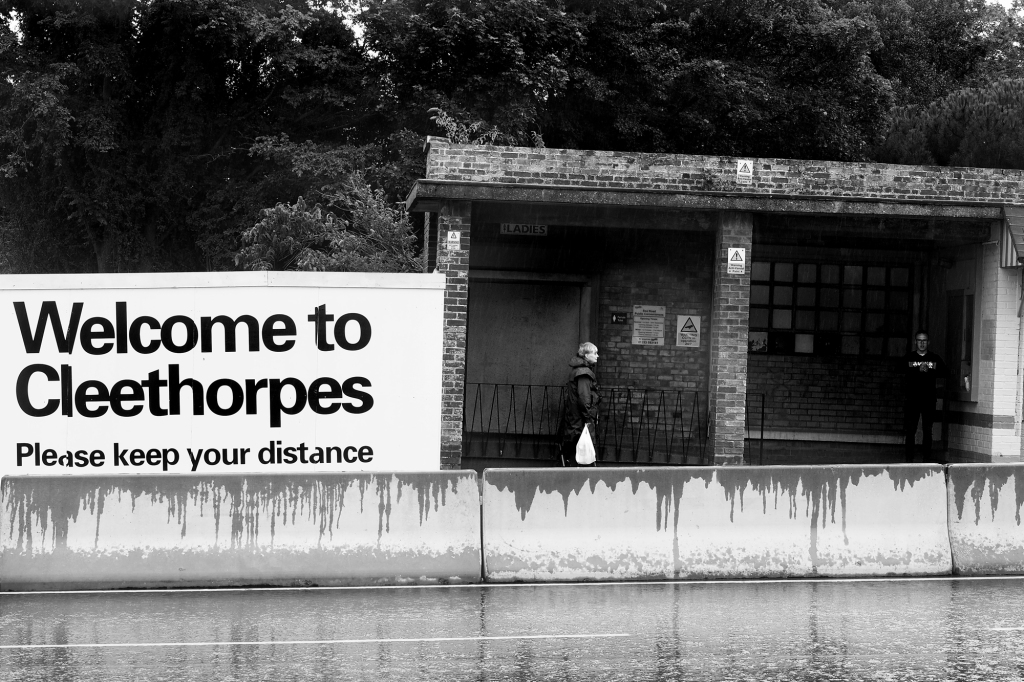
I am reunited with my hometown, Cleethorpes. I have been here for one month after a very long absence and under the strangest of circumstances. Details are unnecessary. The month of July has seen a chaotic and confusing lifting of some lockdown restrictions. I headed for the beach most days, usually at either sunrise or sunset.
July 2020: Cleethorpes
July 2020: Cleethorpes
My photographs are sparsely populated. In the mornings I share the place with joggers, keep fit enthusiasts and their personal trainers, dog walkers, the odd photographer and those who simply sit and watch the spectacle of sunrise in silent reverie.
July 2020: Cleethorpes
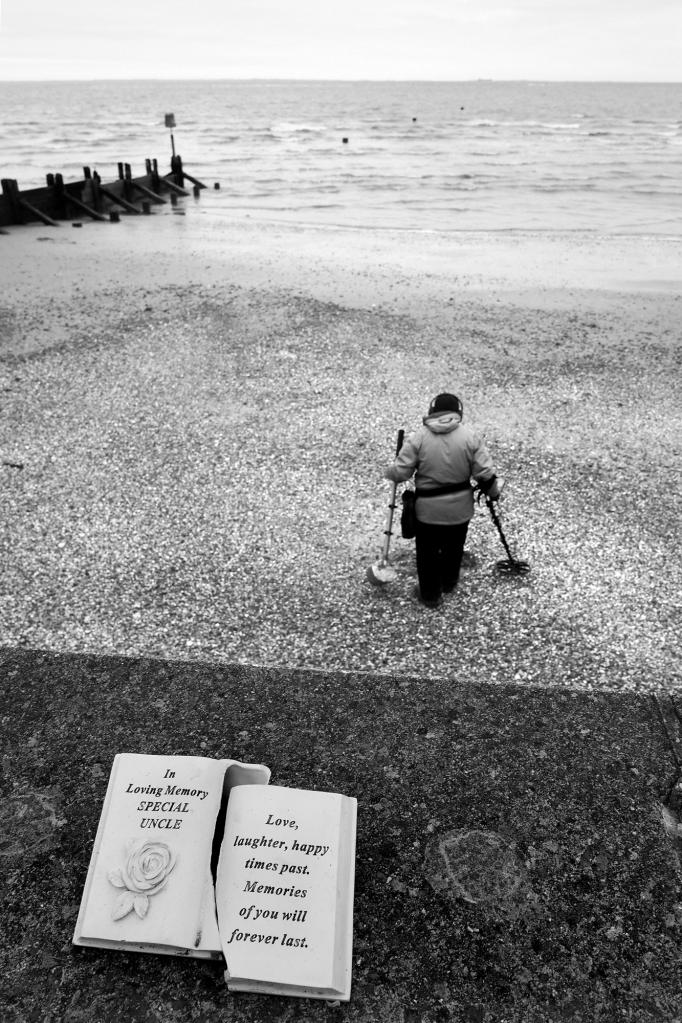
The evenings are slightly busier with the addition of fish and chip shop queues, skateboarders, pub crawlers and those who simply want to make the most of their day out. Sunrise watchers are replaced with those who can enjoy the sunset over the outline of what remains of Grimsby Docks further down-river. The odd detectorist scans the beach for treasure.
July 2020: Cleethorpes
July 2020: Cleethorpes
During the day, particularly if the weather is fine, Cleethorpes remains busy. Not as busy as would be expected under normal circumstances, but busy enough. I have photographs but I am not showing them to you!
July 2020: Cleethorpes
July 2020: Cleethorpes
I have always considered photography to be a very solitary occupation. I have enjoyed days out with a buddy or two, but at the end of the day I am trying to make sense of my world – by myself. Forty-five years of it have taught me a thing or two.
I anticipate the path of an approaching roller skater.
July 2020: Cleethorpes
All photographs were made using an Olympus camera. Many thanks for looking at my blog.
Talat Klong Sip Song Hok Wa in the Lam Luk Ka district of Pathum Thani was once a bustling market community established around the intersection of two klongs (canals) from which its name is derived: Sip Song and Hok Wa. The place, which was also home to a small Chinese community, is largely deserted now and the few families that do live there do so among empty, dilapidated buildings whose occupants have long since departed.
01.02.2020: Talat Klong Sip Song Hok Wa
The once busy klongs, their waters animated by the passage of traffic, are silent now. There is evidence that fishing is an occupation for some, but the still water is only occasionally disturbed by the splash of ‘the one that got away’ or the silent wake of a water rat. If there is any success story to be told here then the clue is in the odd, well-preserved interior you may come across. For these are very popular with filmmakers.
01.02.2020: Talat Klong Sip Song Hok Wa01.02.2020: Talat Klong Sip Song Hok Wa
The ‘talat’ has been used as a location in movies, television shows, advertisements and music videos and goes some way, I guess, to helping provide continuity. For the hour or so I was there I saw no other visitors save a few cyclists who pass through – the area is popular with cycling enthusiasts – and those who attended the few retail establishments weren’t busy.
01.02.2020: Talat Klong Sip Song Hok Wa
The appeal for filmmakers is the authenticity of the available properties: particularly the period furniture. I came across two women about to sit down for lunch in a room full of beautiful examples of this. Though the table, with seating for six more, lent an air of poignancy to the scene. I got the impression that they were no strangers to photo requests; once they had posed for a photograph they seamlessly continued with the job in hand. I then made the photograph I wanted.
01.02.2020: Talat Klong Sip Song Hok Wa
So what of the future, I thought, once the place has ceased to be useful? Will the wonderful pieces end up on a stall in Chatuchak Market, Bangkok? Or maybe grace the dining rooms of well-heeled tourists? One thing thing is certain: it has all been recorded. Many times over.
01.02.2020: Talat Klong Sip Song Hok Wa
The juxtaposition above amused me: the period Thai costume and the nod to one of the most well known of cinematic icons. Looking at the way I framed the image, I am reminded that I owe a great debt to the work of Eugene Atget (1857-1927). A big influence during my time as a student of photography in the 1970s.
01.02.2020: Talat Klong Sip Song Hok Wa
I couldn’t make up my mind about the barbershop: certainly the couple watching television in a far corner were not expecting custom, for I went unnoticed as I hovered in the doorway. A film set? The musical, Sweeney Todd: the Demon Barber of Fleet Street (2007) came to mind. The scene lent itself to the chilling, but in a way that recalled (for me) one of Andy Warhol’s best works: the series ‘Little Electric Chair’ (1964/5). I made my picture and beat a retreat.
Thanks for reading my blog. Camera used was my usual: Olympus OMD EM5 Mk II coupled with a Zuiko Digital short zoom.
I visit my local barber roughly every two months. I have had my camera with me on every occasion, just in case, and once took some photographs of the staff (posed). On a subsequent visit I ensured I had some prints to give away and this stood me in good stead. The owner of the establishment, an endearing, bubbly woman who nominates herself ‘number one barber’, was happy for me to make some photographs a couple of weeks ago: I was third in a queue but it would be a long wait – the guys in front of me were having ‘the works’ – but a fascinating one.
Number One Barber
The ‘works’, it transpired, offered photographic opportunities with results more akin to an ENT clinic than a barbershop. As a kind of drama unfolded I was totally absorbed with what was going on. The guy in the queue behind me had his own way of dealing with the long wait: he took a nap.
Napping at the barbershop
As did one of the guys being dealt with in front of me!
Sweet dreams are made out of this…
The lighting in the place was enough of a challenge to be interesting. The day was a very bright one and the only place I could easily take photographs from – without being in the way – meant I had to make my photographs contre-jour. This is a favourite of mine, however, so no real problems vis a vis exposure. The ear cleaning operation that unfolded involved the use of a small, very bright lamp. This did present a challenge, but I liked the dramatic effect it gave to the scene.
Clocked!
Gently does it
Photographers are always looking for a potential for narrative in their work, and I am no exception. The following pair of photographs – according to me – go some way to achieving this aim. They also demonstrate the importance of scrutiny in post production: the presence of elements within the frame seen and appreciated by the subconscious rather than the eye. These are usually beneficial: in the first photograph I was unaware of the Buddha statue overlooking the scene and in the second my attention was so fixed on the razor that I missed the dog statues on the opposite side of the frame.
Disputing the cost of a delivery…
As we bear witness…
And there you have it. The work of a barber can involve some painstaking and delicate work. My ‘number one’ barber pays incredible attention to detail – my straightforward dry cut takes around 40 minutes on average – and this made for a more productive and enjoyable day than I had imagined I was going to have.
‘Would there be anything else, sir?’
Thanks for visiting my blog. I used my trusty Olympus OMD with a Zuiko short zoom lens for the photographs.
‘There is nothing in this world that does not have a decisive moment’
When Cardinal de Retz (1613-1679) made this statement he was talking from a political perspective, suggesting that the art of leadership is strengthened by the ability to recognise and seize the ‘moment’. The phrase ‘the decisive moment’ came to the attention of the photographic world when it was used as the title of the English version of Henri Cartier-Bresson’s book, ‘Images à la Sauvette’ (1952). Nowadays it is – particularly in the world of social media groups – a buzzword for countless photography enthusiasts and seems to simply relate to the decision – often misguidedly – to press the shutter button. The original, intended meaning – ‘when the visual and psychological elements of people in a real life scene spontaneously and briefly come together in perfect resonance to express the essence of that situation’ (John Suler, The Psychology of the Decisive Moment) is, to some extent, lost.
Winter, Fifth Avenue (1892) by Alfred Stieglitz
One early photographer who embraced the idea of such a moment was Alfred Stieglitz (1864-1946): he appears to have had the patience of a saint (as well as a strong constitution, lol) in waiting for the above moment: three hours in a snowstorm, reportedly. Here are his own words:
‘On Washington’s birthday in 1893, a great blizzard raged in New York. I stood on a corner of Fifth Avenue, watching the lumbering stagecoaches appear through the blinding snow and move northward on the avenue. The question formed itself: could what I was experiencing, seeing, be put down with the slot plates and lenses available? The light was dim. Knowing that where there is light, one can photograph, I decided to make an exposure. After three hours of standing in the blinding snow, I saw the stagecoach come struggling up the street with the driver lashing his horses onward. At that point, I was nearly out of my head, but I got the exposure I wanted.’
I have always enjoyed the resulting photograph for a variety of reasons, not least because I believe the photographer achieved his intention.
Cleethorpes, Lincolnshire: July 2019
Following the stoicism of Stieglitz, it seems somewhat trite to mention that I waited almost five minutes for the photograph above. On the promenade at Cleethorpes. On a sunny day. I had initially been attracted by the shape of tyre tracks in the sand before I noticed a strolling couple on a course that I believed might coincide with those tracks. The judgement proved accurate; the silhouetted figures in the background were, interestingly, all separate and, because my attention was centred on the woman and child, I feel this is an example of luck. Whatever, I only noticed this once I had downloaded my image.
Cleethorpes, Lincolnshire: July 2019
I had to hold my nerve for the snap of the ice cream vendor, above. Only a minute or so wait, camera to my eye, but on a busy-ish day with several passers-by. I was going on the hunch that sooner or later, someone with their head down and involved with a task will look up. I tried to half hide behind a giant plastic ice cream and the result was that luckily, although I was discovered, it appears (to me, anyway) that the attention of the salesperson is drawn to that giant piece of gimmickry.
And on to ‘the lucky break’, unexpected moments that add to the success of an image rather than, as is more often the case in my experience, ruin it. I had already made one photograph of the scene below – I was attracted by the geometry of it – but felt I needed to slightly reposition myself; just as I made the second photograph a figure appeared into the scene. In white, catching the sunlight and carrying a clipboard which made an interesting shape. The intrusion enhanced the photograph in my opinion; the original intention, the play of line and shape, was still there but now there was some human interest. I can’t claim it. Or can I? As the saying goes: ‘you make your own luck’.
Grimsby Docks, Lincolnshire: July 2019
In the course of preparing this blog I came across two very interesting articles. ‘Alfred Stieglitz: The Terminal and Winter, Fifth Avenue’ by Linda Tate (www.thestoryweb.com) and ‘The Psychology of the Decisive Moment’ by John Suler.
My pictures were taken using an Olympus OMD with a Zuiko lens.
‘Now and then, in wandering through the streets, suddenly one comes awake, perceives with a strange exultation that he is moving through an absolutely fresh slice of reality.’
The above quote is from ‘The Eye of Paris’, an essay on the work of the photographer, Brassai written by one of my favourite authors, Henry Miller. In my opinion it is one of the very best pieces of writing on photography and I very much recommend taking a look at it. The quote is significant to me because it defines a phenomenon that I occasionally experience when I’m out and about with my camera: the sudden urge to stop and look for a reason not altogether apparent at the time, perhaps subconsciously driven, as if my mind – far quicker at ‘seeing’ than my eyes – had gently tapped me on my shoulder and whispered, ‘look’.
July 2019: Humber Street, Late Evening
During the four weeks or so I spent in Cleethorpes this year (my hometown – I’m returning for good next summer} I must have walked along Humber Street many times, yet never felt the need to record it as a photograph, save this one instance. And the compulsion to do so was exactly as I’ve described above. The light was constantly changing as fast moving cloud must have been passing over the setting sun and the scene before me appeared flat as I studied it. Once the sunlight broke through again there was a remarkable transformation. The resulting image only has to satisfy the way I felt at the time – the essence of stillness – and for me it does.
When I undertook my ‘street’ portrait project in 1984, I never thought I would be tramping the streets of Scunthorpe, Lincolnshire 35 years later, revisiting those I photographed…
Lisa, 1984
On the 22nd August 2009 I received a message from someone I had met – for barely an hour – 25 years previously:
‘WOW…I totally remember this! I just had my 40th birthday party in America (where I live) and had the actual picture out on display. Everyone LOVED it! I love it too!’
The message was from Lisa and the picture she was referring to is the one that heads this blog. I still have 27 of the original 36 prints I exhibited – simply mounted on card and fixed, in sixes, on large sheets of hardboard I had covered with blackboard paint – at Scunthorpe Museum in 1985. In 2009 I photographed the prints, posted them on facebook and through friends of friends the post reached a homepage in Wisconsin, USA.
I’ve moved around a lot and things get lost; five years ago I discovered the 53 rolls of film that comprised my portrait project – all in perfect condition – in a box of stuff stowed away in my brother’s garage. I felt more could be done and this current project is the result.
A somewhat warmer location than the 1984 one, if I remember correctly
Following her education, Lisa backpacked around Europe and Canada; she worked in a Greek bar and was a fruit picker in Beamsville, Ontario. (Interestingly, Beamsville lies between Lincoln and Grimsby – named after the Lincolnshire county town and the Lincolnshire port, must have seemed like home from home.)
Although Lisa studied jewellery and clothing at Grimsby Art College she works as a financial planner – quite a change of direction I thought – in Milwaukee, Wisconsin. Lisa has lived in the United States for 22 years now, having first gone over when her then partner got relocated from the UK. That relationship faltered and she now lives above the recording studios of her fiancé, Brad (in a rather splendid building I might add).
The new photographs were taken at the home of Lisa’s parents in Scunthorpe the day before she was due to fly back; because the original portrait was one of my favourites I had rearranged the start date of my project. I’m glad I did…
…oh, and Brad reminded me instantly of the singer/songwriter, Neil Young.
Lisa, 2019
Bruce, 1984
Bruce has always worked in the construction industry. He moved to south London in 1987, after Big Red Gun, a band he played bass for, split up. He auditioned with a couple of bands that didn’t really go anywhere, bought a house in Caterham, Surrey in 1990 and didn’t really play for a couple of years.
In 1994 Bruce started playing in a covers band and got to to know ‘some guys with whom I’m still good friends with and still play with to this day.’
‘Whilst playing with function bands The Stonebeats (60s tribute) , The Xscene , and Blondie tribute band, Plastic Letters l had the real pleasure of meeting and playing with a few people who feature in my record collection: Mathew Fischer from Procul Harum, Darren Mooney from Primal Scream and Dave Ruffy from The Ruts.’
Bruce moved back to Scunthorpe in 2006 and bought a couple of properties that he rents out. He is still involved in the local music scene and plays bass with Pointblank. He tells me that he also does ‘a fair bit of ‘depping’, still get the occasional call from the guys down south to cover a gig, always a good catch up.’
Bruce, 2019
Hayley, 1984
I was walking through Central Park, Scunthorpe when I crossed paths with Hayley all those years ago. She was with two friends – one of them was called Heather I recall – and I asked if I could take some photographs, promising not to hold them up for too long. The resulting shot is one of my favourites – though ostensibly nothing more than a snap – which has, for me, a certain ‘je ne sais quoi’ and it is appropriate that I conclude my project with it.
Considering that briefest of encounters, when I met Hayley at her home recently it was like meeting an old friend. She is incredibly easy to chat to, laughs a lot and for the life of me I can’t remember what it was we talked about. She shares her home with her partner and her son and there is a feel of comfort about the place: I remember lots of cushions, fabric, furniture you sink into and interesting things on the walls.
…cushions, fabric, furniture you can sink into…
At some stage of her life so far, Hayley felt she needed a break and decided on a six week trip to visit her uncle in Cape Cod, Massachusetts. This sojourn was to lead to a vastly extended stay in the States. After meeting up with a travelling companion, Hayley took off for the city and lived in both New York and New Jersey. After meeting a guy and marrying him she moved north and spent the following 10 years in Rhode Island.
Hayley is now back in her home town and seemed very settled to me. She works as a community mental health nurse and works for the NHS in the Memory Assessment and Therapy Service.
When I undertook my ‘street’ portrait project in 1984, I never thought I would be tramping the streets of Scunthorpe, Lincolnshire 35 years later, revisiting those I photographed…
Jonathan, 1984
Joanathan has been married – his wife works at the Royal Free Hospital in London – for 27 years and has a daughter who is currently studying film and media at university. I knew him quite well back in the eighties – we played in a band together – and it was great to catch up affter a 30-odd year interval. I remembered him as being a highly animated, enthusiastic and unconventional young man; nothing much has changed and our conversations ran at such a pace, and with such a diversity of topic, that it was difficult to make notes. Luckily, Jonathan provided some outline of his life to date by email:
‘My life is divided between living in London and Burton (editor’s note: a village near Scunthorpe). Bought a flat in Hampstead some years ago so I spend my free time propping up bars in and around Camden and going to gigs. But it’s great to catch up with family and friends in Scunthorpe too. Career-wise I have worked in engineering as a machinist/tool maker; it’s paid for the house and trappings but never really fulfilled the arty side of my personality. I’m now retired from that line of work.’
At the ‘local’: Burton upon Stather, 2019
Jonathan tells me that music has always been an important part of his life. He has always been a member of one band or another for the past 40 years and is now ‘a guitarist in 76 Calling playing anywhere and everywhere.’ He likes to collect vinyl records and is a great fan of record fairs, he also spends some leisure time on a narrow boat he owns. Having explored the canal systems of Northamptonshire, Oxfordshire and Warwickshire, ‘Agincourt’ is now moored at Great Haywood in Staffordshire.
And the Scunthorpe scene all those years ago?:
‘I think fondly of the people I knew back then I think we were lucky to have such a vibrant music scene going on in such a small town. Everyone seemed to get off their arses and do something – whether it was a band, a fanzine or even a shop. If you weren’t playing then your mates were so you would go along and support them: superb. I favoured the Furnace Arms as I thought that place conjured up some great nights of pub rock!’
Jonathan, 2019
Carol, 1984
When I asked Carol – who I remember made all her own ‘going out’ clothes back in 1984 (including those in the photograph) – for her reflections on the past 35 years she answered: ‘I have worked hard and earned nothing’. I feel I, and probably many others, can second that statement…
It would be fair to say that Carol is an academic: she has taught and lectured on English Literature in Scunthorpe and marks papers for a major examination board. She works in a loft in her home – accessed by a ladder – and this provided the setting for my photograph. Carol is unmarried, has one daughter who has made her a grandmother (and me a grandfather, it would be fair to say) and enjoys walking with her dogs, a whippet and a lurcher.
Carol, 2019
Anita, 1984
At 13 years old, Anita was the youngest person I photographed for my 1984 project. Indeed, it was her mother – from whom I had gained permissions from at the time – who reminded her, after spotting a post from me regarding my 2019 plans, that she had taken part. Consequently, the decision to take part was made by Anita at the last moment but she very kindly drove the 30 miles to Cleethorpes just days before I left the UK.
Anita arrived with the youngest of her three daughters, Millie and we embarked upon a short expedition to find a location. After discovering that all three of the Turkish gent’s hairdressers on the main shopping street were unsuitable for one reason or another (well, I thought it a good idea, lol. And Anita is a hairdresser), we adjourned to the Cafe Baraka on the promise of an excellent fruit smoothie I had discovered a couple of weeks earlier.
Since 1984 Anita has worked in a London hotel and in a Scunthorpe sewing factory where she had a hand in providing Marks and Spencer with a finished article. She explained that she had turned to this work because she had wanted a car. Very mobile now, she works as a hairdresser covering the Scunthorpe area.
When I undertook my ‘street’ portrait project in 1984, I never thought I would be tramping the streets of Scunthorpe, Lincolnshire 35 years later, revisiting those I photographed…
‘Finch’, 1984
In 1984, Finch was a popular guy and he still is. He struck me as good humoured, with a realistic outlook on life. He gets on with stuff. Back in the day, Finch was a very active and innovative member of the local music scene; he still makes music and ascribes most of his meaningful friendships to it. His fond recollection of a popular local venue, the Crosby – now closed down – was particularly poignant, so much so that we went there and made some photographs.
Finch is a practical guy – a trait inherited, he says, from his father – and currently spends some of his spare time making improvements to his home; he tackles painting and decorating, plumbing and carpentry with a certain level of skill. He explained to me that all is done by himself, ‘out of necessity, really’. He was turning his attention to his loft space when I visited him so we took a look up there.
Finch (real name Kevin) currently works as a teaching assistant at a local school – he began his career in education as a school bus driver – and enjoys working with youngsters.
‘Finch’, 2019
‘Where meaningful friendships were formed’: ‘Finch’ at the Crosby, Scunthorpe
Sean, 1984
In 1984, Sean was studying teaching at Nottingham. He was an early years teacher for a number of years – focussed eventually on special needs – before setting off to broaden his horizons at schools in Hungary, Kenya, Brunei and the United Arab Emirates.
Sean is well known for his part as bassist in a popular local band, Harry The Spider’s Coming Out Party – the name taken from an early 1980s advert for chocolate – which he formed with his brother, Garry. (Talking about this stirred some good memories for me as, when Sean left the band to study, I became the band’s lead guitarist.) They famously appeared at the first ‘Scunthorpe Free Rock’ concert; an all day annual event put on for free by the local council and which ran for four years. Music is very important to him still and he writes and records his own material.
Sean is currently teaching in Scunthorpe.
Sean, 2019
Kev, 1984
Kev made a special trip into Scunthorpe to meet me and, after reminiscing about the old days – he is an excellent bass player and played with a couple of Scunthorpe’s more successful bands back in the eighties – we adjourned to a multi-storey car park.
Kev had explained that he was a video cameraman and commercial photographer and that his work – making induction films for companies and shooting motorsport, amongst other things – was primarily based in the UK but had taken him occasionally to europe and the USA. The one thing that struck me as I turned my camera on him was that he bore a resemblance to the songwriter, Brian Wilson. To me only it seems, as he had never been told that before. I’m not certain I got anything like I wanted from my camera, but it was great to meet up with him after all those years. He did take a portrait of me – the best I’ve ever had done – with such technical skill that it left me breathless.
Kev, 2019
Simon, 1984
Remembering Simon was a member of a popular local band in 1984, I asked if he had kept up his guitar playing. His response was that he had tried his hand at being a disc jockey and that the experience had ‘tarnished his love of music’. I move on to current interests and discover that he enjoys travelling and is a keen photographer. Then there is: Bridge.
I didn’t know that so many books had been written on Bridge – a popular card game of which I know little about, save that the four players involved are assigned the major compass points – but Simon has a lot of them; hundreds it seemed, glancing at a loaded bookcase. He has, in collaboration with another Bridge expert, designed another language of bidding (I was quite lost at this point, but impressed) called ‘Punk Precision’. Fair play to him. He has played Bridge at county level for both Wiltshire and Lincolnshire and likes to be assigned North or East.
Simon lives in a part of Scunthorpe much developed since the eighties – indeed, I could hardly recognise it – and enjoys family life. He is a draughtsman, a career he embarked upon 40 years ago and which he still pursues.
Simon, 2019
Many thanks go to those who agreed to take part in this project. 1984 photographs were made using a Mamiya 6×6 camera and the recent photographs were made using an Olympus OMD EM5 Mk II camera.






 nic salmon's notes in passing