
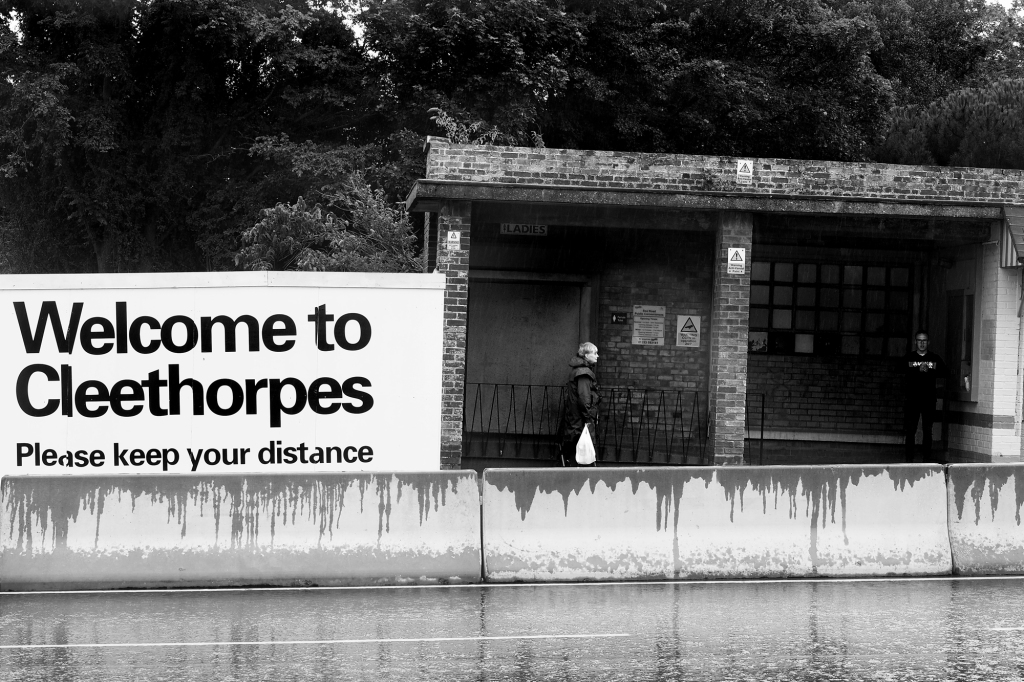
I returned to live in my home town, Cleethorpes in July of last year and have yet to experience ‘normal’ life in this Lincolnshire resort. At the time of writing we are in the middle of a lockdown and I’ve had a quiet Christmas, a quiet New Year and, yesterday, a quiet but significant birthday (I now qualify for a bus pass that allows me free travel in the Grimsby and Cleethorpes area).

On arrival I had to quarantine for 14 days (I had traveled from overseas) and this I did in a holiday let overlooking the river mouth, tantalizingly close to the promenade. A couple of days earlier restrictions had been relaxed following the first lockdown: pubs and restaurants were open once more and, from the garden of my temporary home, I could watch the endless procession of people out to take advantage of the sunshine and sea air. From central Cleethorpes most walk south along the coast as this is far prettier than the walk north towards the port of Grimsby: this takes in a bleaker aspect along an interesting sea defence built in the mid-1970s. And it was the route I often chose once I regained something of my freedom.

The railway line runs alongside the wall and it was in 1953 that the sea took away a significant amount of track. Being a terminus, Cleethorpes is indeed the end of the line and in those days rail travel was a vital link. Quite a disaster. The wall was built, using a stepped design, to put an end to this and other incursions by the tide.

The walk north along the wall is exposed to the elements, the weather can change quickly and, when it does, there is nowhere to shelter: I have been caught out a time or two. On a fine day it provides an interesting walk, a decent place from which to fish or watch a variety of sea birds. Exercise seems to have become increasingly popular during these restricted days and the path is ideal for joggers, cyclists and dog walkers.

At sunrise and sunset the wall, depending upon the cloud cover, provides some interesting colour effects. Very early morning is my favourite time of day, photographically speaking.


As you leave Cleethorpes and enter Grimsby, the wall provides a palette for some of the area’s graffiti artists: an interesting and entertaining gallery is the result.


The title of this post consists three Latin words: caveat needs no explanation for anyone living a life of enforced restriction and ‘cave’ is popular with public schoolboys as a warning to others of impending danger. It kind of fits. But cavea? Here we have a flight of imagination that resulted in my forming a relationship – tenuous at best – between the northern sea wall and a roman amphitheatre. I blame lockdown.

The wall is curved at each end, most dramatically towards the south. Contemplating the scene it occurred to me – in a fanciful way – that it might be nearly half of some vast, ruined amphitheatre. The steps represented the seating – the cavea – from where spectators would, in ancient Rome, watch animal hunts, gladiator games, executions and, oddly but appropriately, mock naval battles. Here in Cleethorpes one might sit and watch the drama of the tides, the coming and going of sea birds and shipping and the gathering of storm clouds on the horizon. At this point it is time to return home…

For the technically minded, the camera I used for these photographs was an Olympus OMD em5 mk II. Thanks for taking the time to look at my blog.






 nic salmon's notes in passing