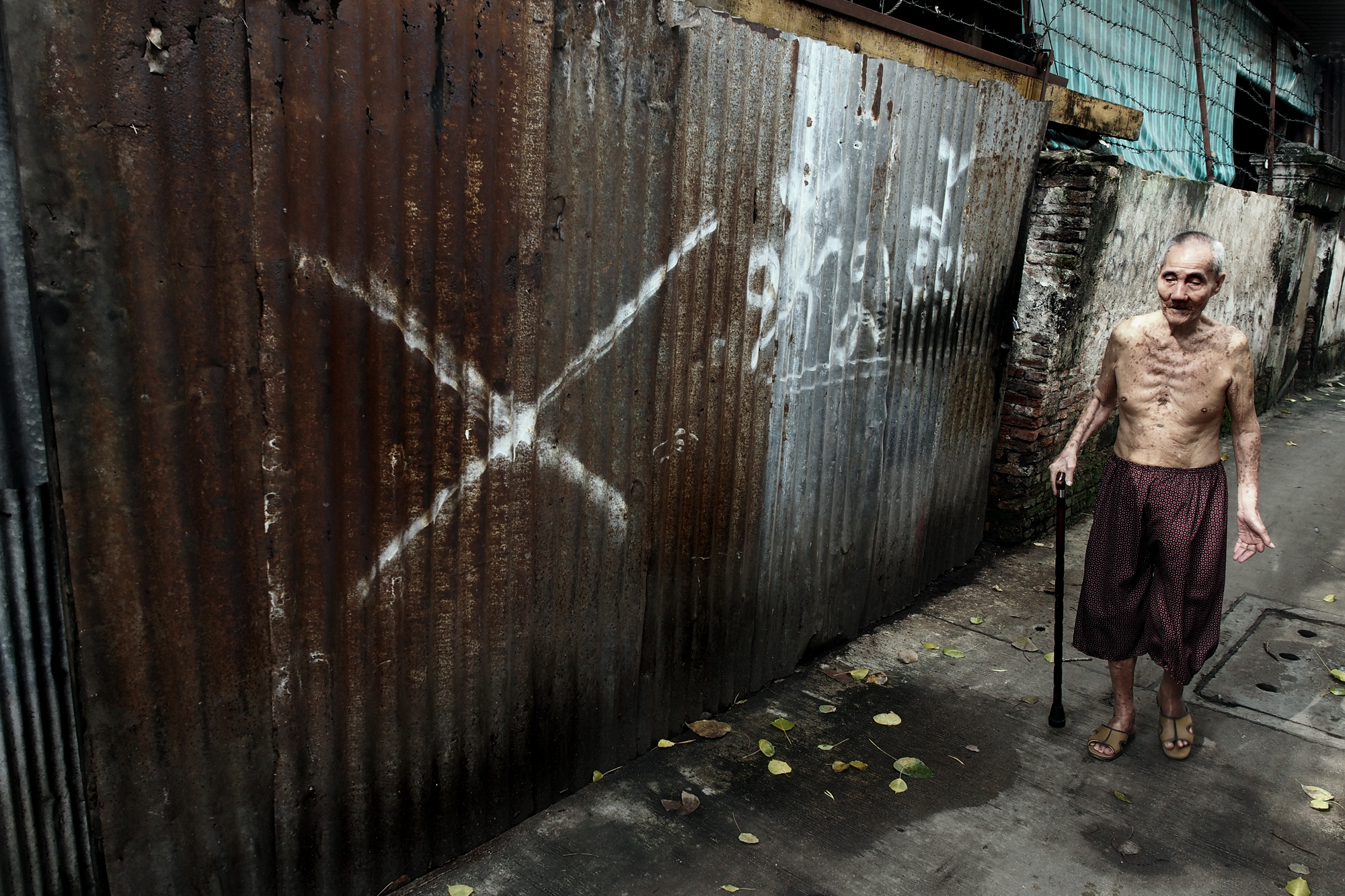
Where time seems to have stood still: once upon a market in Pathum Thani

01.02.2020: Talat Klong Sip Song Hok Wa

Talat Klong Sip Song Hok Wa in the Lam Luk Ka district of Pathum Thani was once a bustling market community established around the intersection of two klongs (canals) from which its name is derived: Sip Song and Hok Wa. The place, which was also home to a small Chinese community, is largely deserted now and the few families that do live there do so among empty, dilapidated buildings whose occupants have long since departed.

01.02.2020: Talat Klong Sip Song Hok Wa

The once busy klongs, their waters animated by the passage of traffic, are silent now. There is evidence that fishing is an occupation for some, but the still water is only occasionally disturbed by the splash of ‘the one that got away’ or the silent wake of a water rat. If there is any success story to be told here then the clue is in the odd, well-preserved interior you may come across. For these are very popular with filmmakers.

01.02.2020: Talat Klong Sip Song Hok Wa

The ‘talat’ has been used as a location in movies, television shows, advertisements and music videos and goes some way, I guess, to helping provide continuity. For the hour or so I was there I saw no other visitors save a few cyclists who pass through – the area is popular with cycling enthusiasts – and those who attended the few retail establishments weren’t busy.

01.02.2020: Talat Klong Sip Song Hok Wa

The appeal for filmmakers is the authenticity of the available properties: particularly the period furniture. I came across two women about to sit down for lunch in a room full of beautiful examples of this. Though the table, with seating for six more, lent an air of poignancy to the scene. I got the impression that they were no strangers to photo requests; once they had posed for a photograph they seamlessly continued with the job in hand. I then made the photograph I wanted.

01.02.2020: Talat Klong Sip Song Hok Wa

So what of the future, I thought, once the place has ceased to be useful? Will the wonderful pieces end up on a stall in Chatuchak Market, Bangkok? Or maybe grace the dining rooms of well-heeled tourists? One thing thing is certain: it has all been recorded. Many times over.

01.02.2020: Talat Klong Sip Song Hok Wa

The juxtaposition above amused me: the period Thai costume and the nod to one of the most well known of cinematic icons. Looking at the way I framed the image, I am reminded that I owe a great debt to the work of Eugene Atget (1857-1927). A big influence during my time as a student of photography in the 1970s.

01.02.2020: Talat Klong Sip Song Hok Wa

I couldn’t make up my mind about the barbershop: certainly the couple watching television in a far corner were not expecting custom, for I went unnoticed as I hovered in the doorway. A film set? The musical, Sweeney Todd: the Demon Barber of Fleet Street (2007) came to mind. The scene lent itself to the chilling, but in a way that recalled (for me) one of Andy Warhol’s best works: the series ‘Little Electric Chair’ (1964/5). I made my picture and beat a retreat.

Thanks for reading my blog. Camera used was my usual: Olympus OMD EM5 Mk II coupled with a Zuiko Digital short zoom.
Chatuchak, Part 1: before the crowds descend

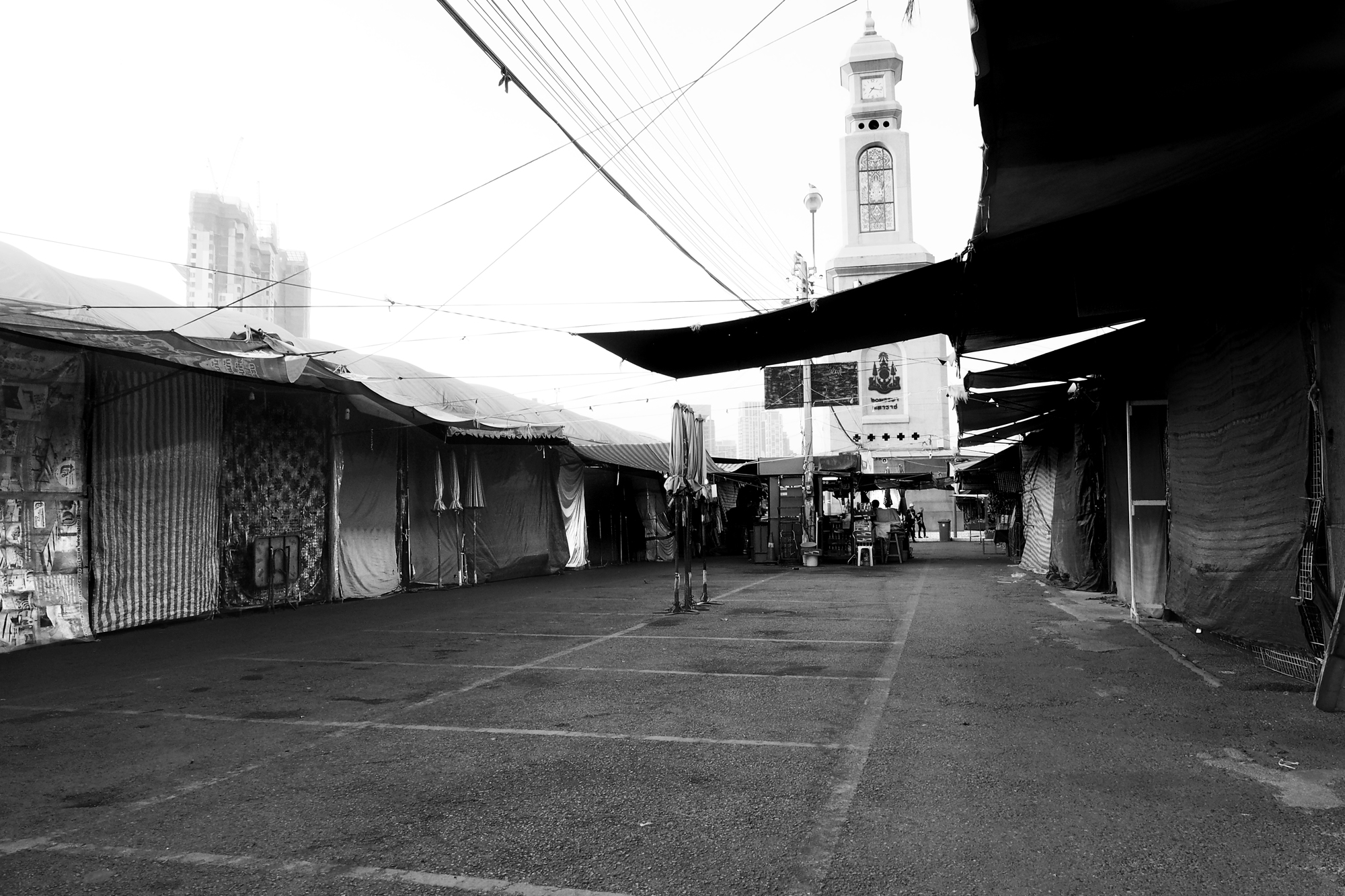
Rendezvous Point: The clock tower dominates the market, 2017

Covering some 27 acres, Bangkok’s Chatuchak Weekend Market is one of the biggest in the world. The market comprises around 15,000 stalls, the bulk of which are arranged grid-like with crisscrossing alleyways – which barely allow the passage of two people abreast – contained within a broad perimeter ‘avenue’. It is from this circulating walkway that the famous Clock Tower can be seen, offering hope for the lost: it is a popular meeting point for that reason. It is here that you can reunite with friends, sit and reflect on the experience or contemplate the wooden ‘croaking frog’ you just bought because, well, one does. I made the photograph above when things came together for me, contre-jour, a little after sunrise. The market largely dormant.

‘In Every Dream Home a Heartache’:2017

I like to visit the market early morning – before the latest contingent of the 200,000 who visit the market annually – because I have the place to myself. Nearly. Sometimes among the lifeless mannequins, the piles of books, t-shirts, souvenirs and other items, the well worn tarpaulin stretched across goods yet to be revealed… life pops up unexpectedly and the market wakes up.

New Morning, Chatuchak: 2017
Trader, Chatuchak: 2017

A benefit, for me, of having a place like Chatuchak to oneself is the chance to look at things closer. Occasionally I spot a detail that gives me a chance to consider what is before me in a more contemplative way, exploring elements of composition, light and shade. This doesn’t happen often, but here are three examples: lights waiting to be switched on, polythene sheets stretched to cover their brimming contents and parasols waiting to be unfurled.

Shutter, Lights, Graffiti: 2017
Polythene: 2017
Parasols: 2017

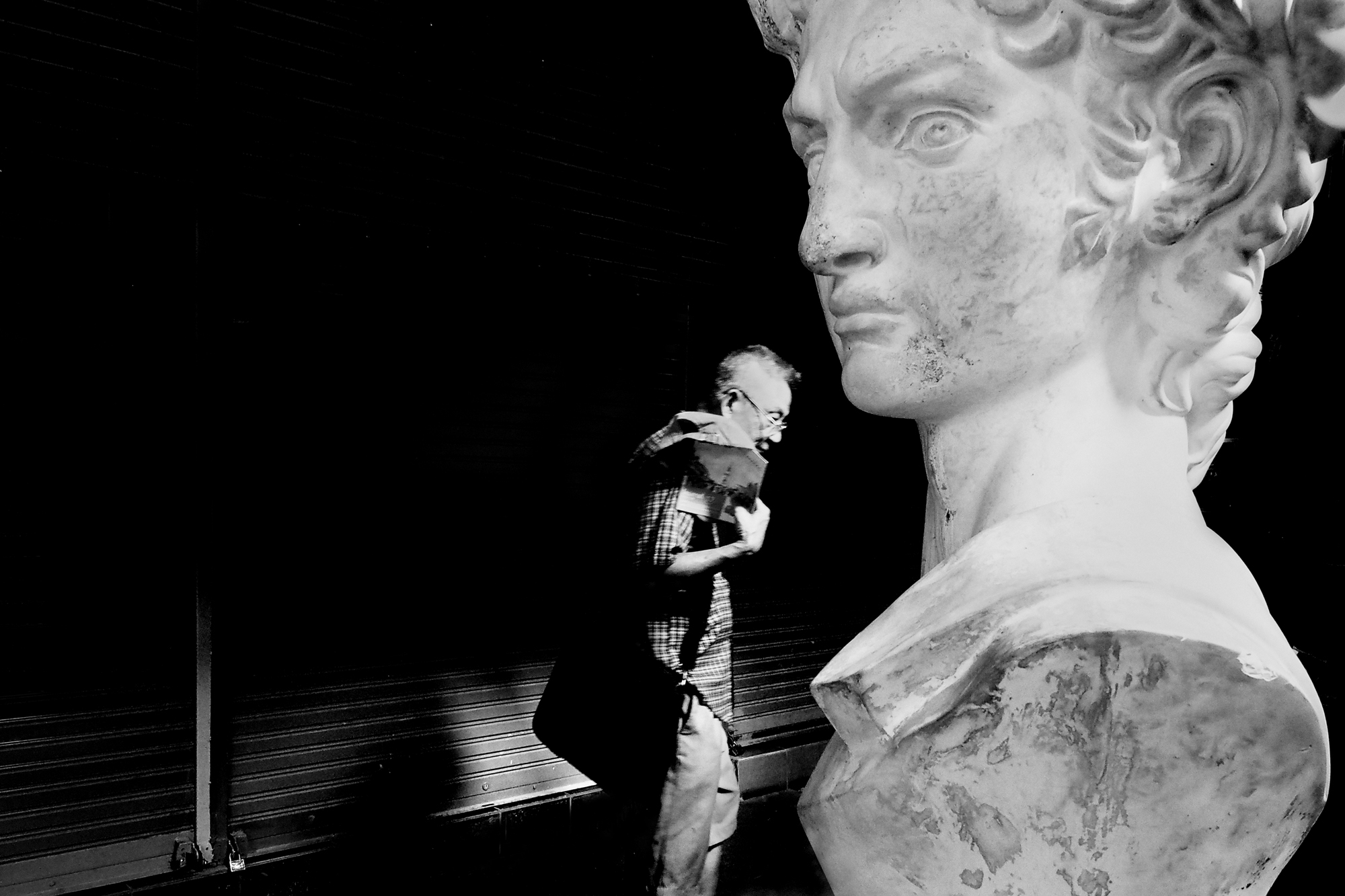
Naturally, as we are in Bangkok, there are oddities: I came across a bust – a replica of some classical work – sat on a table at an intersection in the artists’ zone. It didn’t appear to be on sale and I was having no luck with it. A farang with a briefcase was hurrying along. I picked my moment; on reflection I got it wrong – not the ‘decisive moment’ – but I like it anyway.

The Artists’ Quarter, Chatuchak: 2017

I have a wooden frog somewhere, consigned to a box and hidden away. Perhaps I’ll find it one day and be able to tell someone, ‘look, it croaks!’.

My most familiar 400 metres: A personal street challenge

Day one: Home Guard

It has been just too hot to be out and about lately. And there is only so much scanning of old negatives I can take before the novelty wears off. I needed to be out but I also needed a retreat to the comfort of fans and air-conditioning. I decided to spend some time on my street. Three days, in fact.

Day Three: New build, unoccupied and new build, occupied

My street is quiet. I walk it many times: 300 metres from my house takes me to the point I turn off when taking my daughter to school, 100 metres in the opposite direction takes me to the other end of the street where it joins a busy road. I have walked the street many times as part of my daily routine over the past ten years. I know that there is a solitary pineapple plant on a spot of wasteland and some gorgeously colourful cockerels that peck along the roadside.

Day One: Can he fix it? Yes, he can

I have also noticed recently three new builds. Above are photographs of two of them, the third:

Day One: All will be revealed, but not yet

There is also a house I had never previously taken much notice of that has just undergone a facelift; the choice of colour makes it a stand out attraction now…

Day Two: Yellow house, early morning

Despite the lack of the presence of human activity in the street, there is plenty of evidence of it. I never actually saw painters in action at the house pictured above, but their pots, brushes, rollers and ladders bore testament to their handiwork. I never saw builders as I was taking photographs, but the building progresses daily. It’s almost as if there is a secret world, conspiring to starve me of its portrayal.

Day Two: At the crossroads

The cultural evidence in the street is abundant. This hadn’t really occurred to me until I began to look closely, without the need to get to school on time or buy a bottle of milk before the kettle boils. I find the Buddhist ‘Spirit Houses’ fascinating:

Day Two: Spirit House

In desperation, and needing to find some action, I loitered on my street corner. I was having a cigarette – a favourite (but not recommended) ploy when my intent is a candid photograph – and made this shot between drags:

Day Three: The end of the road

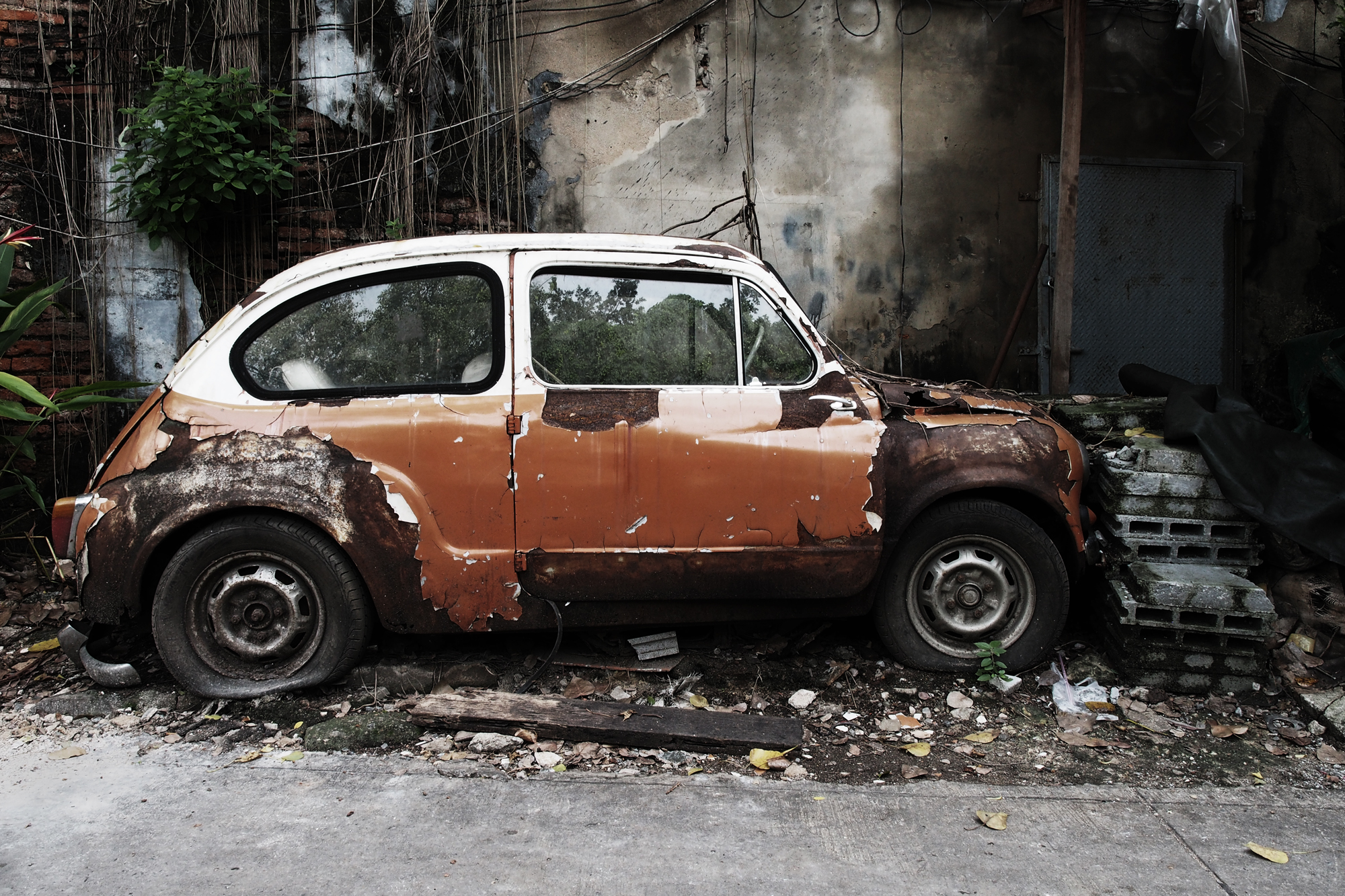
So there you have it. I enjoyed the exercise and was never far away from my front door, water, coffee and fan. I made a photograph of the pineapple plant but didn’t like it. The cockerels ran away at my approach. There was an old car, though:

Day One: Parking space, early morning

Thanks for visiting my blog. All photographs made with an Olympus OMD and a Zuiko short zoom lens.

Talat Noi: the project that was, then wasn’t, then was…

Talat Noi, Bangkok: 2017

Talat Noi is a riverside neighbourhood that sits on the fringes of Bangkok’s Chinatown. I was instantly attracted to it when I made a brief visit in 2017; looking for a project that would be my first in colour – after 40-odd years of monochrome photography – I vowed to return and get cracking. That decision was to cause me a few headaches along the way.

Talat Noi, Bangkok: 2017

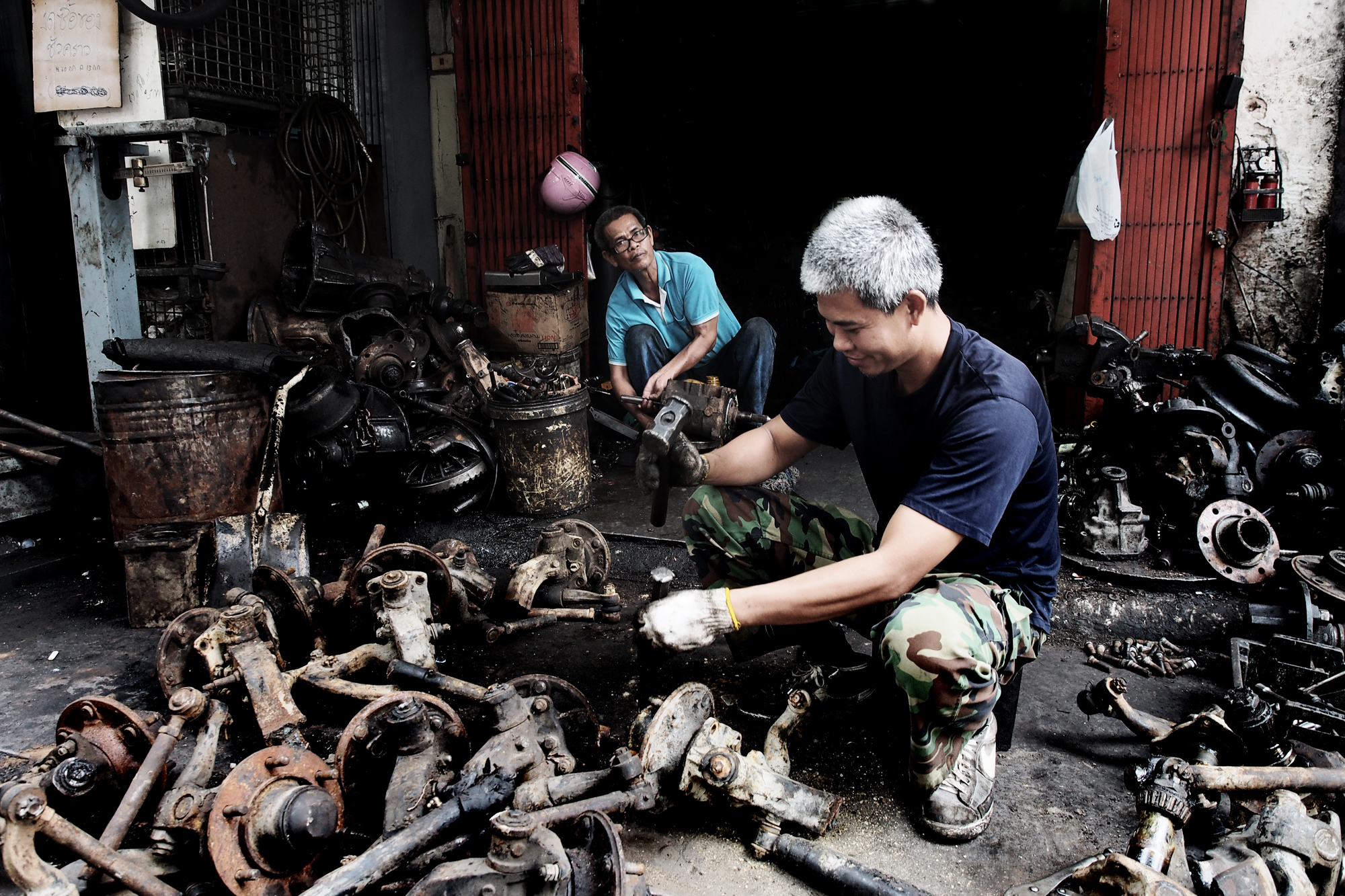
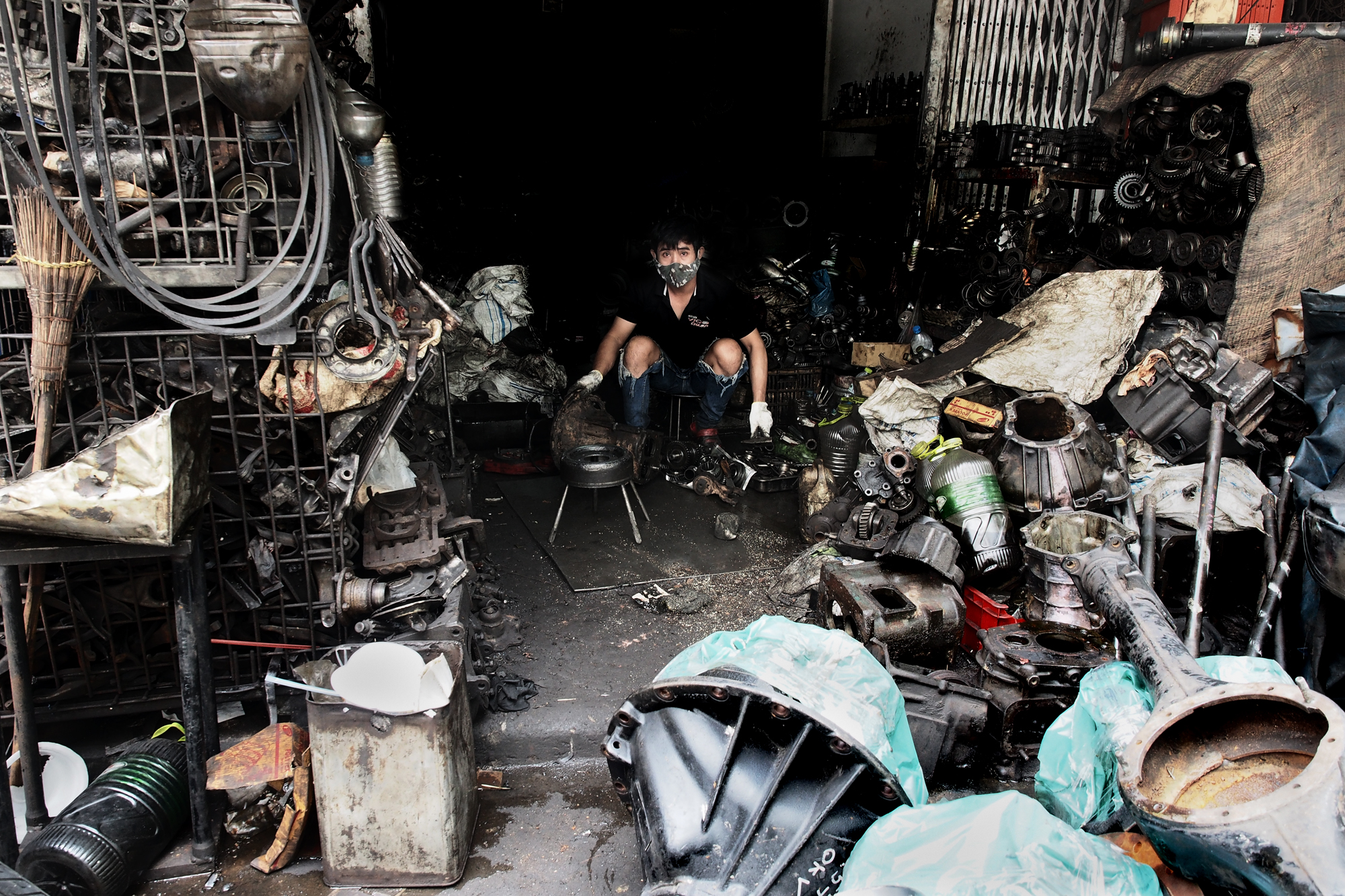
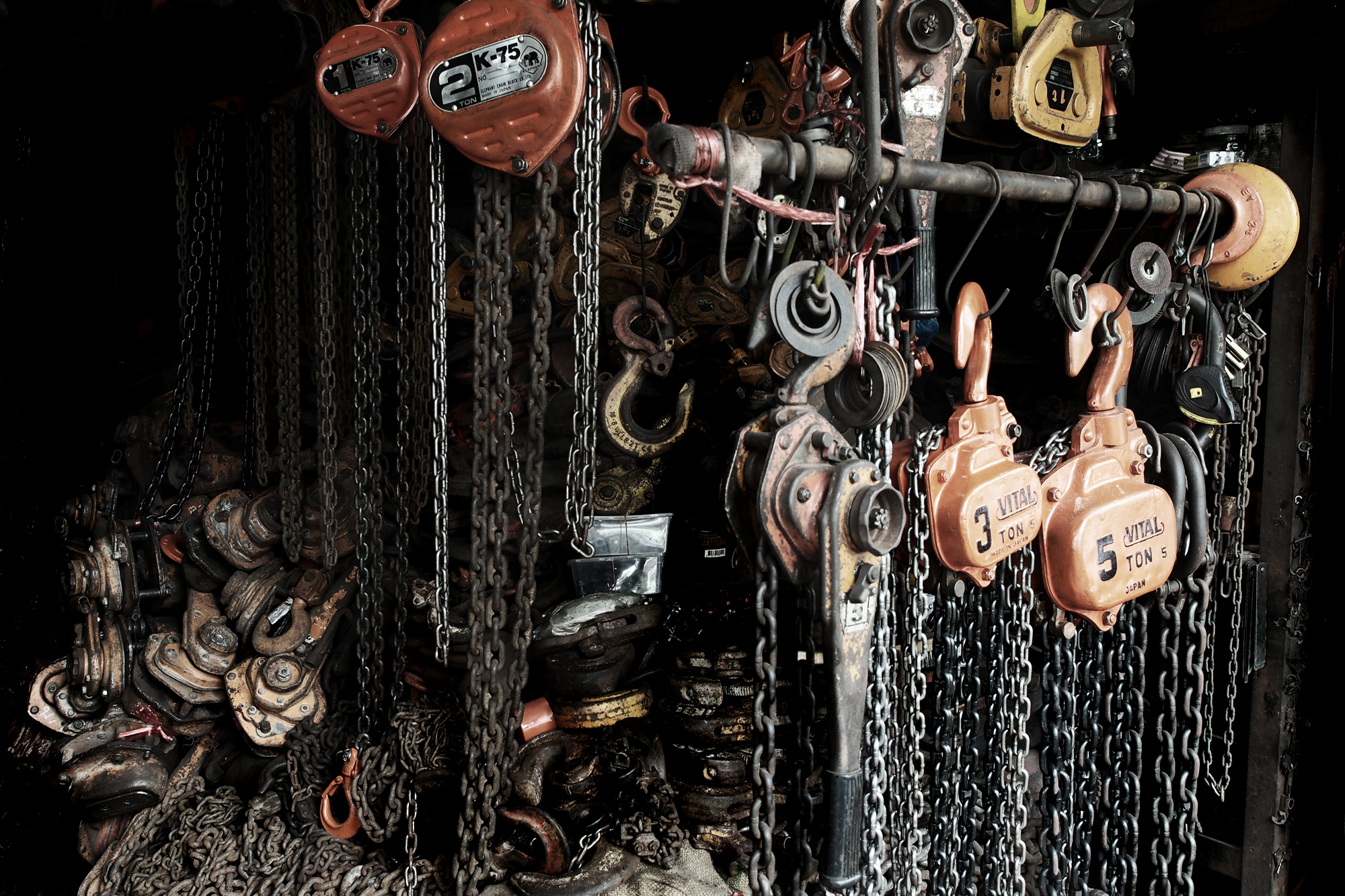
Talat Noi is a collection of streets with one thing in common: salvaged engine parts, millions of them. Great piles of cogs, cylinder heads, axle boxes – all manner of parts. Dirty, oily streets where each workshop is a hive of activity and, I presume, business is done. I wanted my colour photographs to reflect the grime, the ‘unprettiness’ of it all.

Talat Noi, Bangkok: 2017

I devised a technique using layers in Photoshop; a base layer of a very contrasty monochrome version of the photograph over which I placed the original colour photograph which I then reduced in transparency until the effect of the base layer played apart. I liked the desaturating effect of this on the colour.

Talat Noi, Bangkok: 2017

Then I realised that I was just trying to get back to my mono comfort zone; my choice of subject was made, not for the colour, but with monochrome in mind. I had long hard look at this; then went back and shot monochrome.

Talat Noi, Bangkok: 2018

On the whole, it was an unproductive day and very hot. Some of the photographs showed context while some, like the above, did not. But I was getting some interesting (for me) stuff.

Talat Noi, Bangkok: 2018

Plenty of food vendors about in the community. I had a go at shooting colour and not messing about with it:

Talat Noi, Bangkok: 2018

I’ve visited Talat Noi half a dozen times and, after trying various techniques, have decided to give it a rest. I’ve really enjoyed my strolls around this fascinating area and am convinced there is the photograph. Just got to find it. As for the car, on my last trip a month or so ago it was still there and still attracting attention:

Talat Noi, Bangkok: 2019

Thanks for taking the time to visit my blog. All photographs were taken on my OMD EM5 coupled with a Zuiko Digital short zoom lens.

A school, an hour, an education

‘Education is the premise of progress, in every society, in every family.’ (Kofi Annan)

Having the correct documentation I had expected to spend a day at the Mae La refugee camp on the Thai/Myanmar border. As it was, I managed about an hour at a makeshift high school before the party I was with had to hurry off. And what a hugely rewarding hour that was.

It rains a lot during the summer months in Tak Province

I visited in June 2016. Mae La is the largest refugee camp of nine in Thailand; the latest figures (November 2018} show around 32,000 refugees live there, mainly Karen people, with around a third being of school age (5-18 years). The party I was with had helped in the provision of resources for this makeshift school and was escorted by a representative of an organisation that had set up a teaching English training scheme for displaced teachers.

Number 4 High School, Mae La
Auxiliary staff at the teacher training facility

The school was well attended and I found myself welcomed into classrooms much like any classrooms, anywhere. The commitment to learning struck me immediately, though I did manage to disrupt that once or twice:

Clocked!
Classroom scene

Some of the older students live at the school; I caught up with three of them at break time and they gave me a whirlwind tour of their quarters:

A room for two students
The Bathrooms

The boys pictured were keen sportsmen; the school has considerable success in sports competitions – as the trophy shelf shows – despite the small size of the school playground:

The Trophy Shelf
Playground

The child in the photograph above kept her distance but followed me as I made my brief exploration. One day she will be at school, though she has already embarked upon a life of learning and one which, as I know very well, does not stop.

Thanks for visiting my blog: as usual, the camera I used was an Olympus OMD with a Zuiko short zoom.

Parting shot

At the end of the line and what I saw there…

‘Railway termini are our gates to the glorious and unknown. Through them we pass out into
adventure and sunshine. To them, alas! we return.’

The above caption is an observation made by the English novelist, E M Forster (1879 – 1970). He knew a thing or two about travelling and his quote is very apt for the subject of this blog: Bangkok Railway Station.

‘Say cheese’, ‘cheese’, ‘that’s cheesy’

People like having their photograph taken with trains here in Thailand. I have witnessed wedding shots being made at a couple of provincial stations, though never at Bangkok Railway Station – or Hualamphong as it is locally known – …yet.

I have visited the place many times over the years, looking for pictures. More often than not I don’t get them but the experience of being at this perpetually busy place is always an enjoyable one.

Dining Car Kitchen

My favourite time for visiting Hualamphong is very early morning when the overnight trains arrive. The platforms become a hive of activity; passengers, still only half awake, alight, cleaners board, restaurant car staff finish up. Dirty linen is thrown from the train whilst maids and porters execute its transport to the laundry with military precision. By the time I have finished watching this fascinating process the laundry has already fired up a good head of steam.

Need more sleep…..
Baby and Linen
‘Yep….’

Trains are well used in Thailand and offers a cheap way of getting around. The journey times are long (the trip from my local station to Hualamphong, a distance of around 24 kilometres, takes about 45 minutes), but I personally enjoy the leisurely pace.

Fellow passenger, Hualamphong
The prospect of the journey ahead, Hualamphong

Monks frequently travel by rail and occasionally present an opportunity for me to flex my observational, narrative style. The presence of barbers on the platform at Hualamphong has always been a bit of a mystery to me….

‘Haircut, sir?’
Monk and Baggage

I will doubtless return many times to these familiar platforms, coffee shops, ticket offices and washrooms before I head back to the UK. Perhaps I’ll step out into the sun or maybe just hang out until it is time to catch the train home. Either way it’ll be an adventure.

‘Who threw that?’
Someone was in a hurry….

I remember wondering who left those shoes and gloves and under what circumstances, lol. The photographs in this blog were taken on my trusty OMD with a Zuiko short zoom on it. Thanks for visiting, I’ll leave you with someone who had obviously had a very tiring day….

Passenger, Hualamphong

‘Water, water everywhere, nor any drop to drink…’

.

The salt that made seawater undrinkable for Coleridge’s becalmed and despairing ancient mariner is harvested in quantity on the extensive coastal plain of Petchaburi province, Thailand. The low-lying fields are flooded with seawater, dammed and left alone while evaporation takes place.

.

I’ve visited the area on three occasions; on the first two the place was more or less deserted (photographs above), on my third trip, last month, I was lucky enough to find one farm being harvested – and the process is very labour intensive.

.

The salt, having been raked into small piles, is gathered up into shallow rattan and bamboo baskets (photograph above) and each labourer carries two – one at either end of a wooden yoke that is carried over the shoulders. These are tipped onto a growing mound of salt kept tidy by raking (photograph below) prior to being bagged.

.

I didn’t get to see that final stage; it was a baking hot day; my drinking water had run out and I was feeling a little uncomfortable. The one thing that struck me about the work was just how quickly and methodically it was carried out; there was a certain grace in the movement of the workers, a rhythm. As if the whole thing was being orchestrated by an unseen hand, choreographed as well as any ballet. I was lucky enough to get an image that goes some way (for me) towards describing that visually and I’ll leave you with it.

.

For the tech-minded, the camera used was an Olympus OMD EM5 c/w a Zuiko Digital 12-40mm lens.

Why I Like My First Generation OMD

…………………………………………………………………………………………………………………………………………………..

The photograph above provides a clue as to why, when switching from film to digital (I put that move off for as long as I could), I chose to stay with Olympus. The OMD EM5 had the same feel as the OM1 I had been using when out and about in the many streets, byways and highways I have been walking for nearly 40 years.

1984, Scunthorpe (UK) Olympus OM1 c/w Zuiko 135mm lens

I studied photography at Trent Polytechnic in Nottingham (UK), graduating in the late 1970s. During the early 1980s I tried to make a go of it, but never managed to become a professional photographer; since then I have continued to do project based work for myself and have a visual diary of my life so far which is hugely satisfying.

2018: Talat Noi, Bangkok, Olympus OMD EM5 c/w Zuiko Digital 12-40mm

I bought my first OM1 in 1980 along with a Zuiko standard lens. I added to my lens collection over the next few years and bought another body too, I still have all the gear and it all still works fine. The photograph below shows everything I had possessed up until my change to digital.

My old Olympus gear, shot with my OMD!

The great thing is that, using an adapter, I can use my old lenses on my digital camera. The focal length alters, of course, but it gives me options. Or gave me; to cut a long story short, my shutter failed whilst trying out my old 200mm lens and I can’t get it into my head that this was probably nothing to do with the lens. This happened a couple of years ago and I’ve never used the adapter since. My bad. I was only a week or so without a camera, Olympus Thailand did a great job in replacing the shutter and the repair was way, way cheaper than having to shell out for a new body, which I couldn’t afford to do anyway. This episode didn’t put me off Olympus cameras and mine has worked fine since then.

1984, Scunthorpe (UK) Olympus OM1 c/w Zuiko 200mm lens

I haven’t been able to get out of my old habit of occasionally looking through the viewfinder for quite a time, waiting for things to come together; this didn’t matter in the old days but can be a problem with the digital video display, due to battery drain. Easily remedied by carrying a fully charged spare battery, just in case. Luckily I don’t make that many photographs – almost as if it was still 1980 and I was down to my last roll of tri-x – and this economy means I can continue to work as I always have.

2015: Hualamphong, Bangkok. Olympus OMD EM5 c/w Zuiko 17mm lens

Though I mainly use my short zoom I did buy a Zuiko digital 17mm lens. This is a very small lens and, with an aperture of f1.8, it’s pretty fast. Coupled with the compact size of the OMD, it is perfect for those times when I don’t want to be too visibly a photographer; I’ve never used a camera bag either, much for the same reasons. And I tend to dress down, but I digress. So there you go; I’ve looked at other cameras, including the second and third generation OMDs, but have yet to be tempted. It may be that the things are too expensive and I can’t afford to change – or it may be that I am quite happy with what I’ve got.